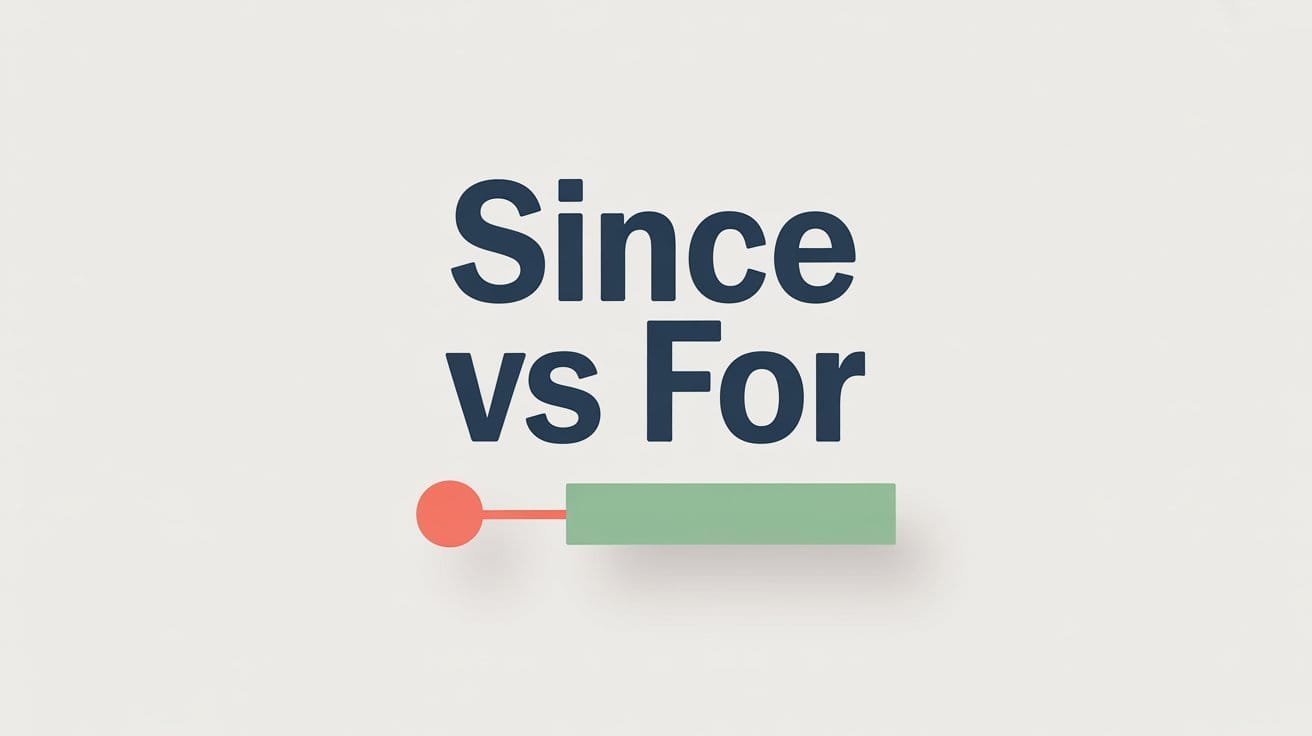
Since and for are both used to talk about time, but they do not mean the same thing. Mixing them up can make a sentence sound incorrect, even when the idea is clear.
The difference is simple once you see it. Since points to a starting moment, while for talks about how long something lasts. The confusion usually happens because both are often used with the present perfect tense and appear in similar sentences.
When to Use Since
Use since to talk about the starting point of an action or situation. It refers to a specific moment in time, not a length of time.
Since answers the question: From when?
Examples:
- She has lived in Toronto since 2018.
- He has not checked his email since Monday morning.
- They have been friends since college.
In each sentence, since introduces the exact time when something began.
Important to note:
Since is most commonly used with perfect tenses, especially the present perfect, because it connects a past starting point to the present.
Examples:
- He has worked here since July.
- She has been studying English since last year.
Using since with a time period, such as two years or a long time, is incorrect because those expressions describe duration, not a starting point.
When to Use For
Use for to talk about duration. It tells you how long an action or situation lasts, not when it started.
For answers the question: How long?
Examples:
- She has lived in Toronto for five years.
- He waited for thirty minutes outside the office.
- They have been friends for a long time.
In these sentences, for introduces a period of time rather than a specific moment.
For can be used with different tenses, not only the present perfect. It works whenever the focus is on length or duration.
Examples:
- He stayed there for two weeks.
- She studied quietly for an hour before the exam.
The key difference to remember is simple: since points to a starting time, while for measures how long something continues.
Since vs For in Sentences
Seeing since and for side by side makes the difference much clearer. Both sentences may describe the same situation, but the focus changes.
- She has worked at the company since 2020.
- She has worked at the company for four years.
The first sentence highlights when the work started. The second focuses on how long it has continued.
Here’s another comparison:
- He has been feeling tired since Monday.
- He has been feeling tired for three days.
Again, since introduces a specific starting point, while for shows duration.
You can often switch between since and for if you change the time expression. What matters is keeping the meaning consistent. If the sentence points to a moment, use since. If it measures time, use for.
Common Mistakes with Since and For
Even though the difference between since and for is clear, mistakes still happen. Most errors come from mixing up starting points and time periods.
Using Since with a Duration
Since should not be used with a length of time.
Examples:
- She has lived here since five years.
- She has lived here for five years.
A duration like five years needs for, not since.
Using For with a Starting Point
For does not work with specific moments in time.
Examples:
- He has worked here for 2019.
- He has worked here since 2019.
A date, day, or moment always takes since.
Forgetting the Tense Connection
Since often appears with perfect tenses because it connects the past to the present. Using it with the wrong tense can sound unnatural.
Examples:
- She works here since 2021.
- She has worked here since 2021.
Since vs For: Quick Comparison Table
| Preposition | Used For | Think of It As | Example |
|---|---|---|---|
| Since | Starting point in time | From a specific moment | She has worked here since 2019. |
| For | Duration of time | Length of time | She has worked here for five years. |
When you hesitate, pause and ask:
- Am I naming a point in time (a date, day, moment)? → Since
- Am I naming a length of time (hours, days, years)? → For
If you answer that correctly, the preposition choice becomes obvious.
Frequently Asked Questions About Since and For
Can since and for be used in the same tense?
Yes. Both since and for are commonly used with the present perfect tense, but they serve different purposes. Since connects the action to a starting point, while for focuses on the duration. The tense stays the same, but the meaning changes based on the preposition.
Is since always used with the present perfect tense?
Most of the time, yes. Since usually works with perfect tenses because it links a past moment to the present. However, it can also appear in other structures when the meaning is clear, such as in clauses that explain time relationships.
Can I use for with the present simple tense?
Yes. For can be used with many tenses, including the present simple, past simple, and present perfect. What matters is that the sentence talks about how long, not when something started.
What is the most common mistake with since and for?
The most common mistake is using since with a duration or for with a specific time point. Remember that since needs a starting moment, while for needs a time length.