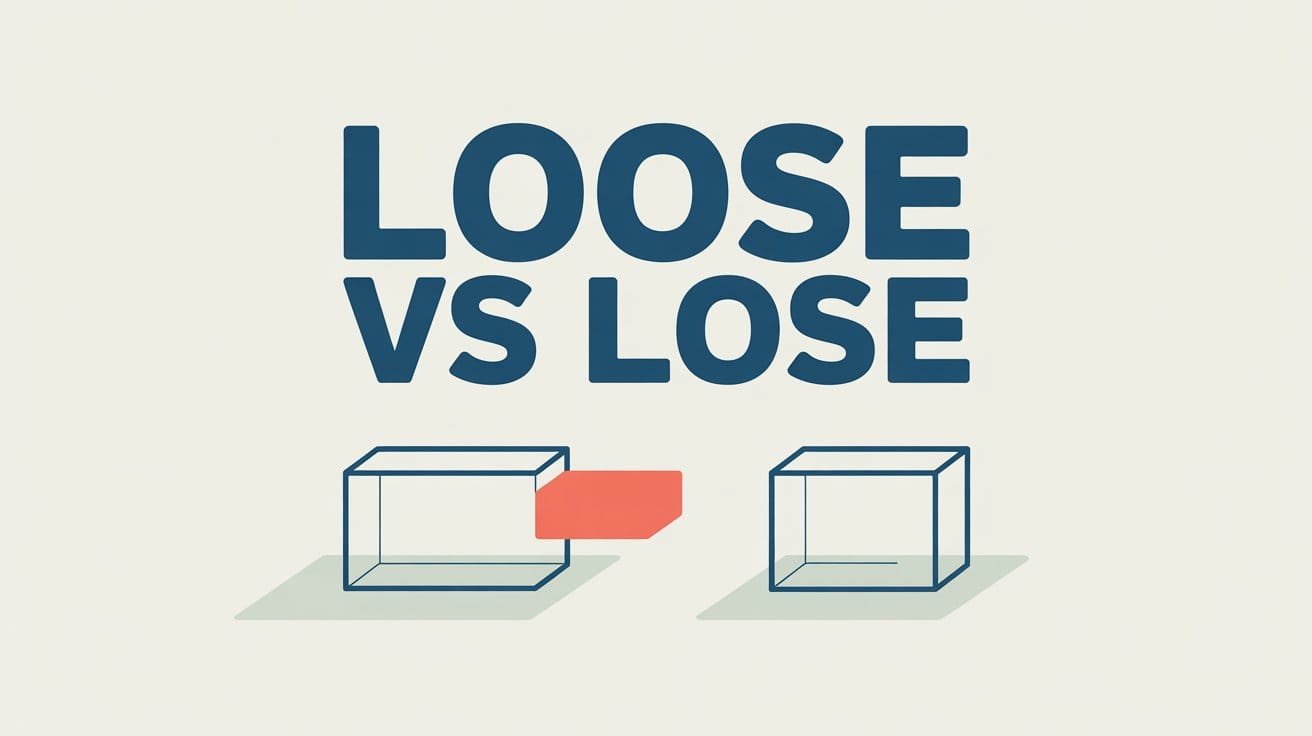
Loose vs. lose is a common source of confusion because the words look similar and are often mistyped, especially in quick writing. One describes something that is not tight or not firmly fixed. The other is a verb that means to misplace something or fail to keep it.
The confusion usually happens because the spelling difference is small, but the meanings are completely unrelated. Using the wrong word can change the meaning of a sentence or make it sound careless, particularly in professional or academic writing.
What Does “Loose” Mean?
Loose is an adjective. It describes something that is not tight, not firmly fixed, or free to move. It can also describe things that are not strict or tightly controlled.
If the word is describing the condition or state of something, loose is usually the correct choice.
Loose in a Sentence
These examples show how loose is used in everyday and professional contexts:
- The handle feels loose and needs to be tightened.
- He prefers loose clothing when working long hours.
- There is a loose cable behind the desk.
- The rules were kept intentionally loose during the trial period.
- A loose page slipped out of the notebook.
In each example, loose describes a condition or quality. It does not describe an action.
What Does “Lose” Mean?
Lose is a verb. It means to misplace something, fail to keep something, or not win. Unlike loose, it always describes an action or result, not a condition.
If the sentence is about something going missing, being reduced, or not being won, lose is the correct choice.
Lose in a Sentence
These examples show how lose is used in clear, real-world contexts:
- Be careful not to lose your access card.
- The team did not want to lose momentum after the break.
- She tends to lose focus when working late.
- You may lose data if the system shuts down unexpectedly.
- He did not want to lose the opportunity by delaying his response.
In each example, lose describes an action or outcome. Something is being misplaced, reduced, or not retained.
Loose vs. Lose: Side-by-Side Comparison
Although loose and lose look similar, they function very differently in a sentence. The difference becomes clear when you look at role and meaning.
| Word | Part of speech | Meaning | Example |
|---|---|---|---|
| Loose | Adjective | Not tight or not firmly fixed | The screw is loose. |
| Lose | Verb | To misplace, fail to keep, or not win | Try not to lose your keys. |
Compare Them in Sentences
- The bolt came loose during transport.
- She did not want to lose track of time.
If the word is describing a condition, use loose.
If it is describing an action or result, use lose.
A Simple Way to Remember Loose vs. Lose
A quick way to tell these two apart is to focus on the extra “o” in loose.
Loose has two o’s, which can remind you of something open, relaxed, or not tight. If you can imagine space, movement, or slack, loose is usually the right word.
Lose has one o and is about loss or failure. If something goes missing, slips away, or is not won, lose fits the sentence.
You can also use this quick check while editing:
- Can you replace the word with not tight? → use loose
- Can you replace it with misplace or fail to keep? → use lose
This small spelling cue helps prevent one of the most common typing mistakes in English.
Common Mistakes With Loose and Lose
Even though the meanings are very different, loose and lose are often mixed up in writing. Most mistakes happen because the words look similar and are typed quickly without checking meaning.
A common error is using loose when the sentence describes an action. For example, writing “I don’t want to loose my files” is incorrect because the sentence is about misplacing something. The correct verb here is lose.
Another frequent mistake is using lose to describe a condition. Sentences like “The button is lose” appear often, but lose cannot describe a state. The correct adjective is loose.
These errors are especially common in emails, messages, and online comments, where spellcheck may not flag the mistake since both words are valid.
When editing, pause and ask:
- Is something not tight or not fixed? → loose
- Is something missing, reduced, or not won? → lose
Correct and Incorrect Usage Examples
Seeing loose and lose used side by side makes the difference much easier to remember.
Example Set 1
Incorrect: Be careful not to loose your ID card.
Correct: Be careful not to lose your ID card.
The sentence is about misplacing something, so the verb lose is required.
Example Set 2
Incorrect: The door handle feels lose.
Correct: The door handle feels loose.
Here, the word describes a condition, which makes loose the correct choice.
Example Set 3
Incorrect: She did not want to loose the client’s trust.
Correct: She did not want to lose the client’s trust.
Trust can be lost, not loosened.
Example Set 4
Incorrect: There is a lose wire under the table.
Correct: There is a loose wire under the table.
The word describes how the wire is positioned, not an action.
Once you focus on whether the word describes a state or an action, these mistakes become much easier to catch.
Loose vs. Lose in Writing
In writing, the mix-up between loose and lose often happens in fast, informal contexts like emails, messages, and online posts. Because both words are common and look similar, the mistake can slip through easily.
In professional writing, lose appears more often when discussing outcomes, risks, or results. For example, writers talk about losing data, losing time, or losing opportunities. Using loose in these cases can make the writing seem careless.
Loose is more common in descriptive writing, instructions, and technical contexts. You might describe a loose connection, loose clothing, or loose materials to explain a condition that needs attention.
By slowing down and checking whether the sentence describes an action or a condition, you can choose the correct word naturally and avoid one of the most common spelling errors in English.