
You can pronounce every sound correctly and still sound unnatural. The problem is often word stress.
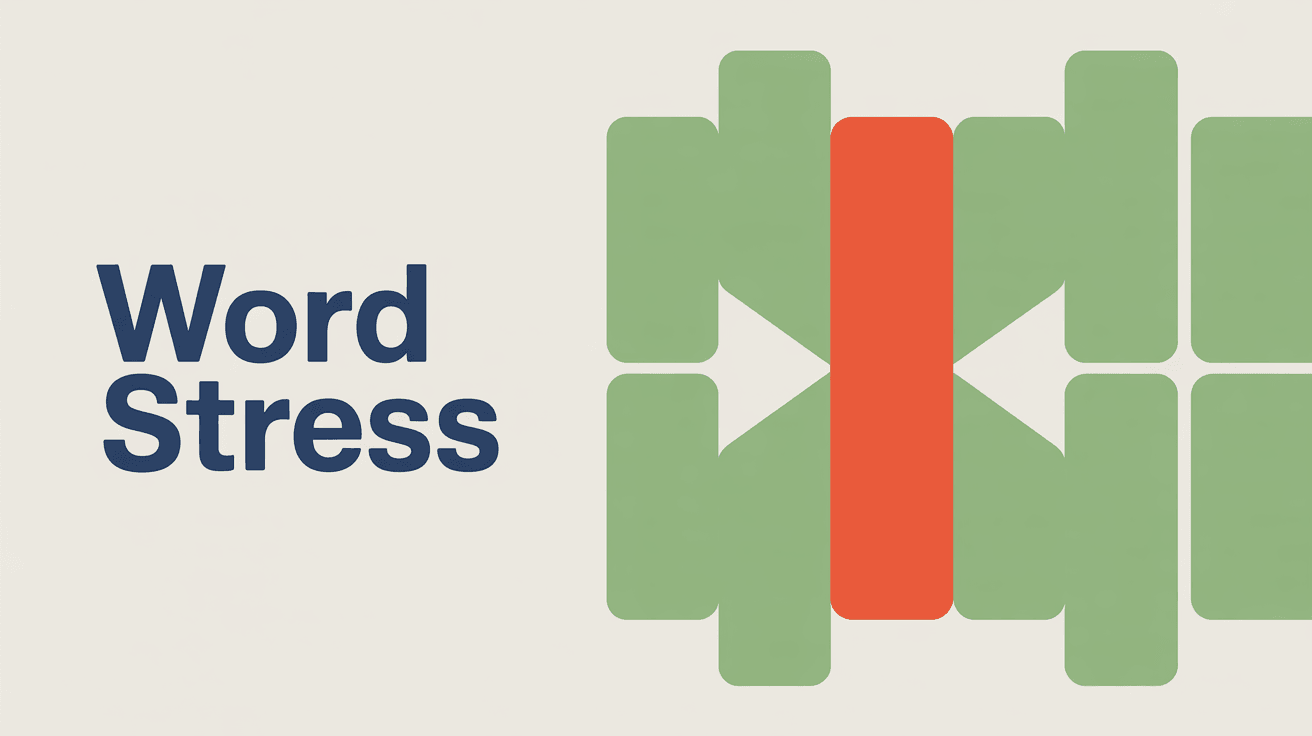
In English, not every part of a word is equal. One syllable is stronger. It is slightly louder, longer, and clearer than the others. This is what we call word stress.
When you place stress correctly, your speech sounds smooth and easy to understand. When you don’t, even simple words can sound unfamiliar or confusing.
Quick Summary of Word Stress Rules
- Every English word has one main stressed syllable
- Stress is placed on vowel sounds
- Many words follow patterns based on endings
- Unstressed syllables are often reduced
- Listening helps more than memorizing
What Is Word Stress in English?
Word stress is the emphasis placed on one syllable in a word. The stressed syllable is louder, longer, and clearer than the others, which helps create natural rhythm in spoken English.
When you say a word, you do not pronounce every part equally. One syllable stands out. This gives the word its natural rhythm.
Examples:
- TAble (first syllable stressed)
- beGIN (second syllable stressed)
- comFORtable (middle syllable stressed)
If you stress the wrong syllable, the word can sound unfamiliar or harder to understand, even if the sounds are correct.
Why Word Stress Is Important in English
Word stress helps people understand you quickly. It guides the listener to recognize the word without extra effort.
It also:
- Makes your speech sound more natural
- Improves clarity in everyday communication
- Helps listeners identify words faster
- Prevents confusion between similar words
Even small stress mistakes can make a common word sound unusual. When the stress is correct, your speech flows more smoothly and feels easier to follow.
Types of Word Stress in English
Not all stressed syllables sound the same. In English, some syllables are stronger than others. Understanding these levels of stress helps you speak more naturally and hear patterns more clearly.
Primary Stress (Main Stress)
Primary stress is the strongest emphasis in a word. This syllable is the most noticeable. It is louder, slightly longer, and clearer than the rest.
Every English word has one primary stress.
Examples:
- eduCAtion
- reLAX
- TAble
- aROUND
If you change the position of primary stress, the word can sound incorrect or confusing.
Secondary Stress (Weaker Stress)
Secondary stress is a lighter emphasis that appears in longer words. It is not as strong as the primary stress, but it is still slightly noticeable when you say the word naturally.
You will usually find secondary stress in words with three or more syllables.
Examples:
- ˌeduCAtional
- ˌinforMAtion
- ˌecoNOMical
- ˌphotoGRAphic
In these words:
- The primary stress is the strongest syllable (CA, MA, NOM, GRA)
- The secondary stress is weaker but still present (edu, infor, eco, photo)
Where Does Word Stress Fall in a Word?
Word stress does not appear randomly. In many words, it follows common positions. Learning these positions helps you recognize stress more quickly.
Stress on the First Syllable
Many common nouns and adjectives have stress on the first syllable.
Examples:
- TAble
- WINdow
- HAPpy
- DOCtor
This pattern is very common in everyday vocabulary.
Stress on the Second Syllable
Many verbs and some longer words place stress on the second syllable.
Examples:
- reLAX
- arRIVE
- beGIN
- forGET
If you move the stress to the first syllable, the word may sound incorrect.
Stress on the Second-to-Last Syllable (Penultimate)
In longer words, stress often falls on the second-to-last syllable. This is especially common in words with certain endings.
Examples:
- geoGRAPHic
- draMAtic
- eduCAtion
- inforMAtion
What to Notice
- Short words often follow simple patterns (first or second syllable)
- Longer words often depend on word endings
- One syllable will always stand out more than the others
How to Identify Word Stress in a Word
You do not need to guess word stress. There are simple ways to find it quickly and accurately.
Listen for the strongest syllable
Say the word at a natural speed. One part will sound stronger than the others.
Examples:
- aROUND
- reLATE
- hoTEL
The stressed syllable is the one that stands out clearly.
Break the word into syllables
Split the word into parts and say it slowly. Then repeat it naturally.
Examples:
- in-ter-EST → interEST
- com-mu-NI-ty → commuNIty
Breaking the word makes the stress easier to notice.
Use a dictionary
Most dictionaries show word stress with a symbol (ˈ). It appears just before the stressed syllable.
Examples:
- aˈround
- reˈlate
You do not need to learn phonetic symbols in detail. Just look for where the stress is marked.
Notice how the word changes in different forms
Word stress often shifts when the form of a word changes.
Examples:
- PHOtograph → phoTOGraphy → photoGRAphic
- ecoNOMic → ecoNOmics
Common Word Stress Patterns in English
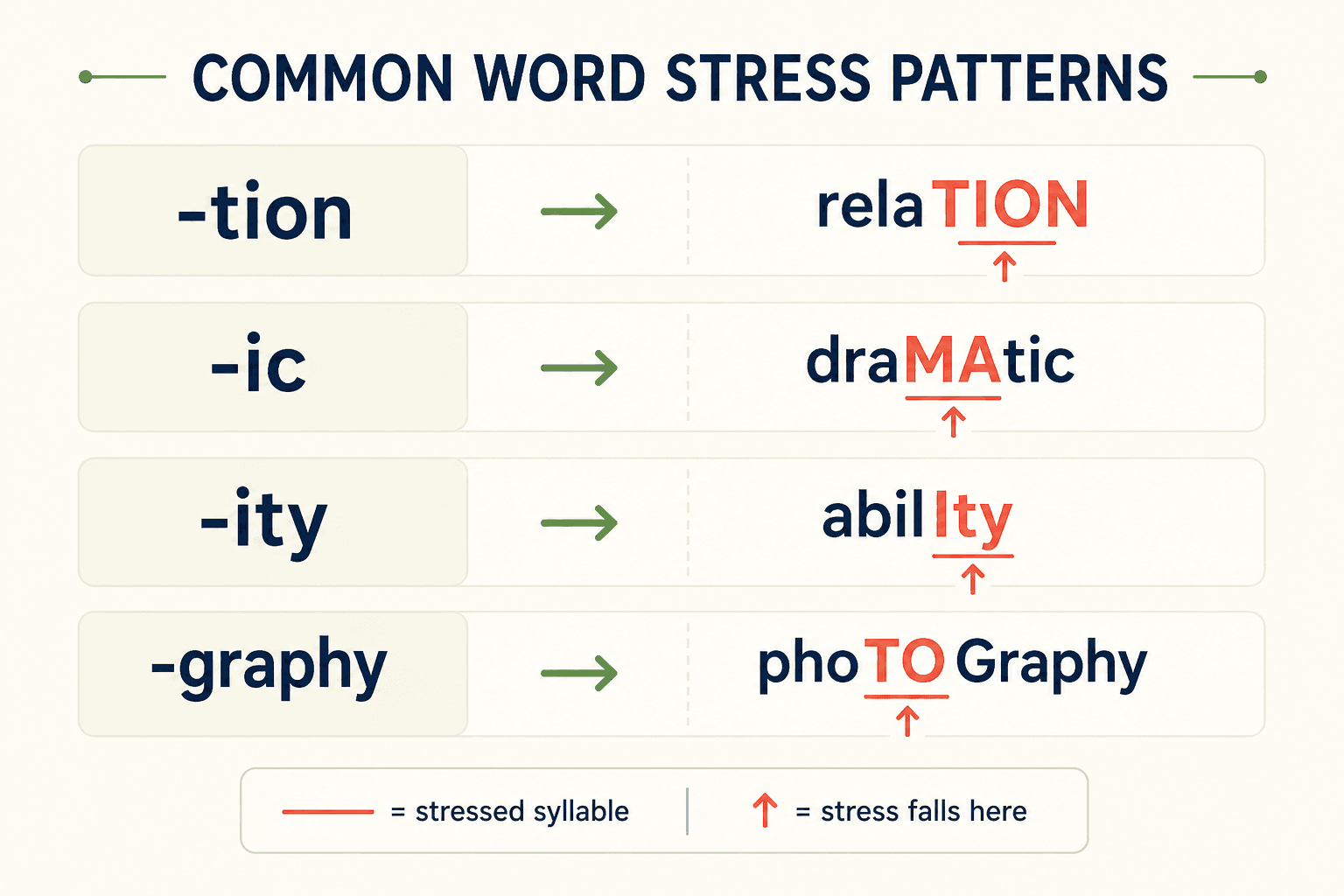
You do not need to memorize the stress of every word. English follows patterns, especially based on word endings. Once you learn these patterns, it becomes easier to predict where the stress will fall.
Quick Pattern Table
| Ending | Stress Rule | Examples |
|---|---|---|
| -tion / -sion | Stress before the ending | relaTION, disCUSsion, teleVIsion |
| -ic | Stress before the ending | draMAtic, athLEtic, realIStic |
| -ity | Stress before the ending | abilIty, curiosIty, densIty |
| -graphy / -logy | Stress before the ending | phoTOGraphy, biOLogy, geOGraphy |
Two-Syllable Words (Nouns vs Verbs)
In many two-syllable words, stress depends on whether the word is a noun or a verb.
Most nouns are stressed on the first syllable.
Most verbs are stressed on the second syllable.
Examples:
- TAble (noun) vs reLAX (verb)
- PREsent (noun) vs preSENT (verb)
- REcord (noun) vs reCORD (verb)
This is one of the most useful patterns to learn.
Words Ending in -tion / -sion
The stress usually comes just before the ending.
Examples:
- relaTION
- disCUSsion
- teleVIsion
Words Ending in -ic
The stress usually falls on the syllable before -ic.
Examples:
- draMAtic
- athLEtic
- realIStic
Words Ending in -ity
The stress usually falls before -ity.
Examples:
- abilIty
- curiosIty
- densIty
Words Ending in -graphy / -logy
The stress is usually placed before the ending.
Examples:
- phoTOGraphy
- biOLogy
- geOGraphy
Longer Words (3+ Syllables)
Longer words often follow patterns based on their endings, but one syllable will always stand out more clearly.
Examples:
- inforMAtion
- eduCAtional
- comMUnity
Weak Syllables and the Schwa Sound (/ə/)
Not every syllable in a word is strong. In fact, most syllables are weak. Understanding weak syllables is key to sounding natural in English.
What Is a Weak Syllable?
A weak syllable is an unstressed part of a word. It is softer, shorter, and less clear than the stressed syllable.
When you speak naturally, you do not give equal importance to every part of a word. Strong and weak syllables create rhythm.
What Is the Schwa Sound?
The most common sound in weak syllables is the schwa (/ə/). It sounds like a short, relaxed “uh”.
This sound appears in many unstressed syllables.
Examples:
- aBOUT → “uh-BOUT”
- aGO → “uh-GO”
- SUPport → “SUP-urt”
- probLEM → “PROB-ləm”
The vowel sound changes and becomes weaker, even if the spelling is different.
If you pronounce every vowel clearly, your speech may sound unnatural. Native speakers reduce unstressed syllables.
What to Focus On
- Strong syllables are clear and emphasized
- Weak syllables are softer and often reduced
- The schwa sound appears in many unstressed syllables
How Word Stress Affects Pronunciation
Word stress does not just change which syllable sounds stronger. It also changes how the word itself is pronounced.
When you understand this, your pronunciation becomes more natural and easier to follow.
Stressed Syllables Sound Clear and Strong
The stressed syllable is pronounced with:
- A clear vowel sound
- Slightly more volume
- A longer duration
Examples:
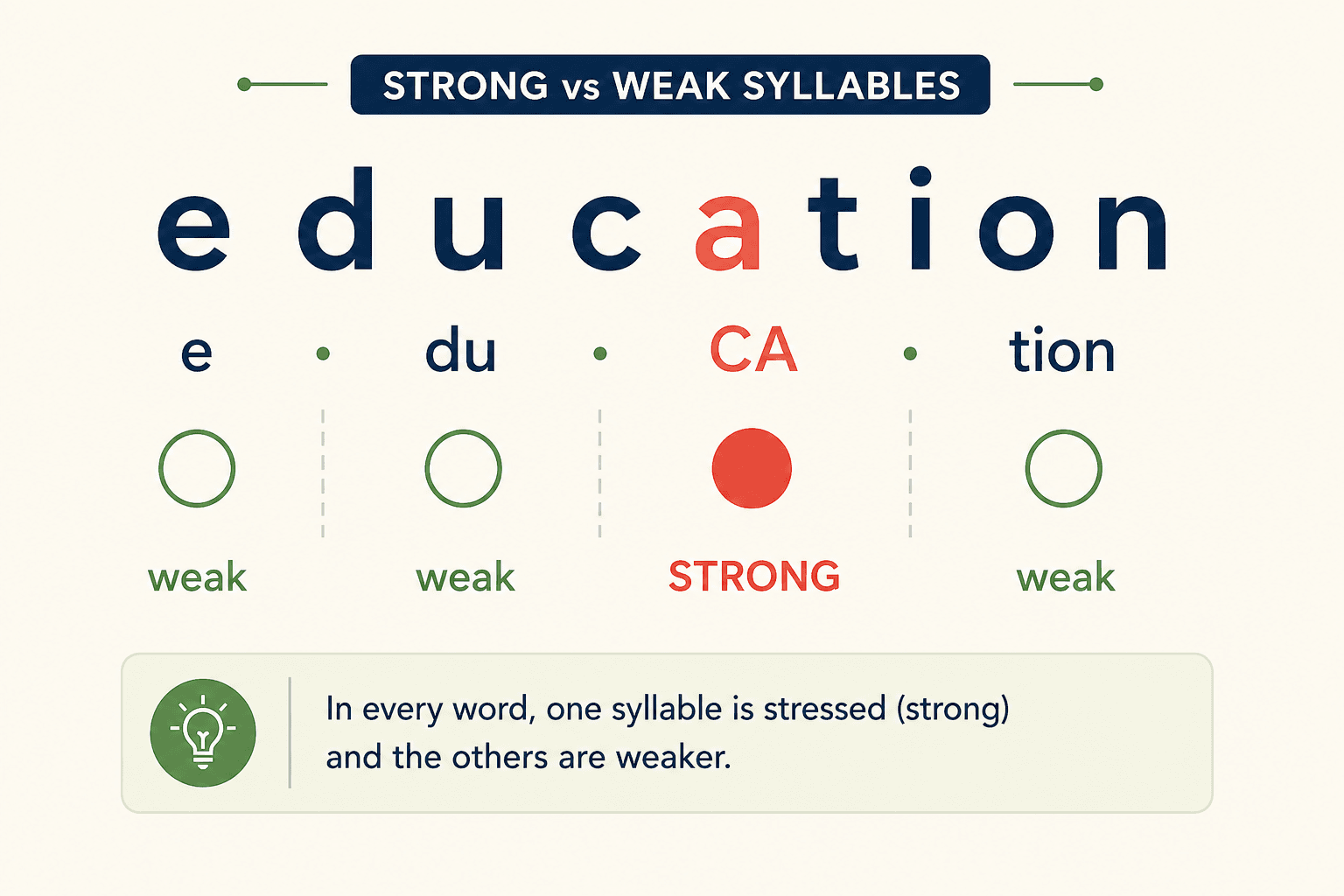
- eduCAtion → “CA” is clear and strong
- reLAX → “LAX” is emphasized
- TAble → “TA” stands out
If you remove the stress, the word loses its natural rhythm.
Unstressed Syllables Become Weaker
Unstressed syllables are softer and less clear. They are often reduced in real speech.
Examples:
- aBOUT → “uh-BOUT”
- SUPport → “SUP-urt”
- comMUnity → “kuh-MYU-ni-tee”
You can see that some vowels change or become less distinct.
Vowel Sounds Change in Unstressed Syllables
In many cases, vowels in unstressed syllables change to a neutral sound (schwa /ə/).
Examples:
- phoTOGraphy → the first “o” becomes weak
- baNAna → “ba-NA-na” (first and last syllables are weaker)
This is why English pronunciation often sounds different from spelling.
Word Rhythm Depends on Stress
English has a rhythm based on strong and weak syllables.
Example:
- comMUnity → strong–weak–weak–weak
- eduCAtion → weak–weak–strong–weak
If every syllable is stressed equally, the word sounds unnatural.
Word Stress That Changes Meaning
In some English words, the spelling stays the same, but the meaning changes depending on which syllable you stress.
This is common in two-syllable words where the noun and verb forms have different stress patterns.
Common Examples
- REcord (noun) → a stored piece of information
- reCORD (verb) → to capture or register
- PREsent (noun) → a gift
- preSENT (verb) → to give or show
- OBject (noun) → a thing
- obJECT (verb) → to disagree
- INcrease (noun) → a rise
- inCREASE (verb) → to grow
- CONduct (noun) → behavior
- conDUCT (verb) → to carry out
What to Remember
- Nouns usually have stress on the first syllable
- Verbs usually have stress on the second syllable
- The spelling does not change, but the meaning does
Correct word stress helps you communicate clearly, especially with words that look the same but mean different things.
Word Stress vs Sentence Stress
Word stress and sentence stress are different, but both affect how natural your English sounds.
Word Stress (Inside a Word)
Word stress focuses on one syllable within a single word. This syllable is stronger than the others.
Examples:
- reLAX
- TAble
- comMUnity
Only one part of the word stands out.
Sentence Stress (Across a Sentence)
Sentence stress focuses on important words in a full sentence. These are usually content words like nouns, verbs, and adjectives.
Example:
I WANT to BUY a new PHONE
In this sentence, the stressed words carry the main meaning.
Key Difference
Word stress → emphasis within a word
Sentence stress → emphasis across a sentence
You need both to sound natural:
- Word stress helps you pronounce words correctly
- Sentence stress helps you express meaning clearly
When you combine both, your English sounds more fluent and easier to understand.
Quick Practice Exercises
Practice helps you move from understanding to using word stress naturally. Try these short exercises.
Identify the Stressed Syllable
Say each word aloud. Notice which syllable is stronger.
- PHOtograph
- phoTOGraphy
- eduCAtion
- comMUnity
- inforMAtion
Focus on making one syllable slightly louder and clearer.
Meaning-Based Practice
Say both forms and notice the difference in stress.
- REcord (noun) vs reCORD (verb)
- PREsent (noun) vs preSENT (verb)
- OBject (noun) vs obJECT (verb)
This helps you connect stress with meaning.
Sentence Practice
Use word stress in full sentences.
- I need more inforMAtion before I decide.
- She will preSENT the report tomorrow.
- This REcord is very important.
Notice how word stress works together with sentence rhythm.
Say It Naturally
Say these words slowly, then repeat them at a normal speed:
- aROUND
- reLAX
- phoTOGraphy
- eduCAtion
- geOGraphy
The goal is not perfection. Focus on rhythm and clarity.
Important Note About Exceptions
Word stress in English follows patterns, but it is not completely predictable. There are many exceptions.
Some words do not follow the usual rules. Others may change stress based on usage, context, or even regional pronunciation.
Examples:
- hoTEL (not HOtel)
- maCHINE (not MAchine)
- poLICE (not POlice)
These words may not match the common patterns you learned earlier.
What This Means for You
- Use patterns as a guide, not a fixed rule
- Always listen to correct pronunciation
- Confirm with a dictionary when unsure
Patterns will help you most of the time. Listening will help you the rest of the time.
Start Noticing Word Stress in Everyday English
The fastest way to improve word stress is to start noticing it around you.
Listen carefully when people speak. Pay attention to which syllable stands out in each word. You will begin to hear patterns you may not have noticed before.
When you learn a new word, do not just focus on spelling or meaning. Notice how it sounds. Repeat it out loud with the correct stress.
You can also:
- Pause and repeat words while watching videos
- Check pronunciation when reading new vocabulary
- Practice speaking slowly, then at a natural speed
The more you pay attention to word stress, the more natural it becomes. You do not need to get every word right immediately. Even native speakers rely on familiarity and listening.
As you practice and hear more English, correct word stress becomes easier and more natural.
FAQs
What is word stress in English?
Word stress is the emphasis placed on one syllable in a word. The stressed syllable is louder, longer, and clearer than the others.
How do you identify stressed syllables?
You can identify stressed syllables by listening to how the word is spoken, breaking it into syllables, or checking a dictionary that marks stress.
Why is word stress important?
Word stress improves clarity, helps listeners understand you quickly, and makes your speech sound more natural.
Can word stress change meaning?
Yes. Some words change meaning depending on which syllable is stressed.
Example: REcord (noun) vs reCORD (verb)
Is word stress the same as sentence stress?
No. Word stress focuses on one syllable in a word, while sentence stress highlights important words in a full sentence.

The First English Grade Editorial Team creates simple English grammar, vocabulary, and language guides for students, beginners, and everyday learners.