
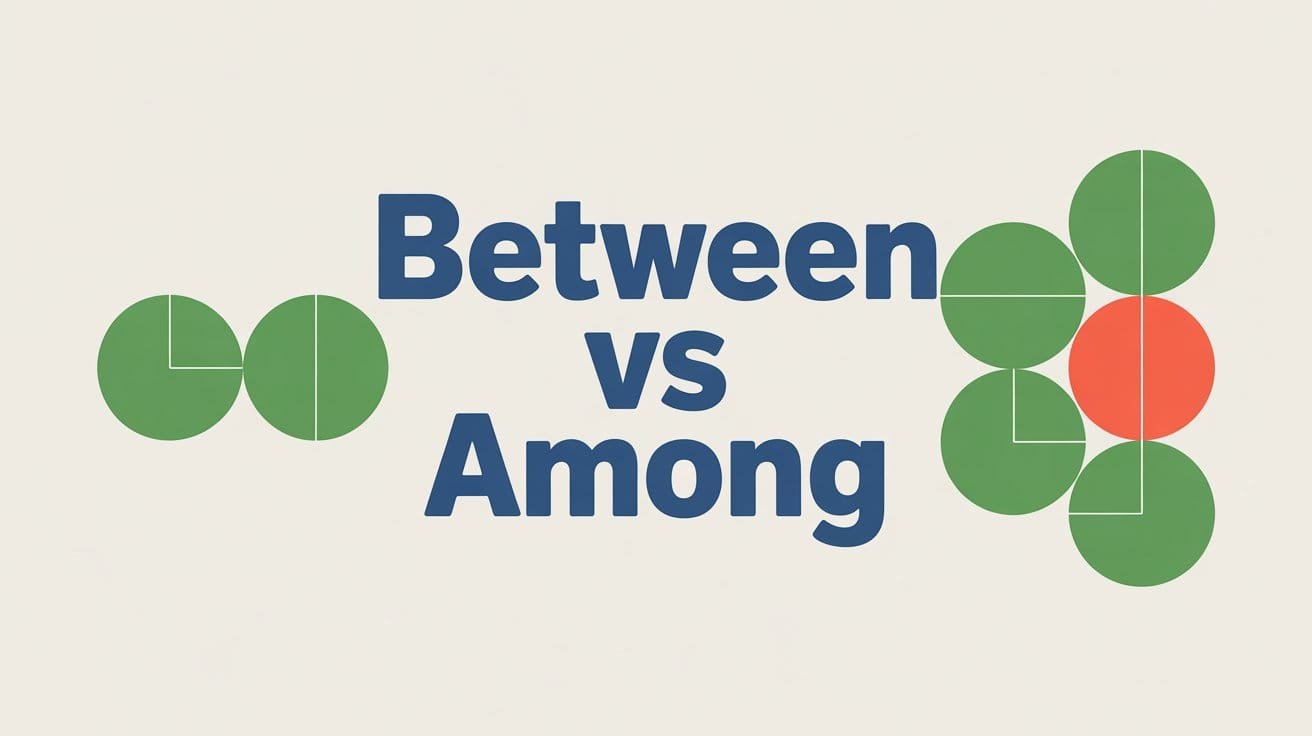
Between and among are easy to confuse because both can describe relationships involving several people or things. The usual advice that between is for two and among is for three or more sounds simple, but it does not always work.
You can use between with more than two when the people or things are considered separately, while among is usually more natural when they are treated as part of a group.
The real difference is less about counting and more about how the people or things are connected in the sentence.
Between vs Among: The Main Difference
The clearest distinction is based on how the people or things are being considered.
| Word | Main idea | Example |
|---|---|---|
| between | separate or individually considered entities | The discussion between the three managers lasted an hour. |
| among | someone or something within a group | The announcement caused surprise among the staff. |
Use between when the relationship involves distinct people, things, points, or choices.
Use among when the focus is on membership in, movement through, or a condition shared within a group.
When to Use Between
Use between when people, things, places, times, or choices are considered separately.
The café sits between the courthouse and the public library.
The disagreement between the project leads delayed the launch.
She had to choose between the morning and evening sessions.
The office is open between 9 AM and 5 PM.
These sentences involve identifiable points, alternatives, or relationships.
You will also commonly see between with comparisons, differences, connections, and relationships:
The report explains the difference between revenue and profit.
Communication between the legal and finance teams improved after the restructuring.
The important idea is separation or individual identity, not simply the number involved.
When to Use Among
Use among when someone or something is part of, surrounded by, or included within a group.
Maya felt comfortable among colleagues she had known for years.
The missing contract was buried among hundreds of archived files.
Support for the proposal was strongest among younger employees.
Here, the members are not being compared or related one by one. The group provides the setting.
Among is also natural for feelings, opinions, conditions, or behavior shared within a group.
Frustration grew among residents after the second delay.
The new policy quickly became popular among university students.
The emphasis is on what is happening within the group collectively.
Can You Use Between for More Than Two?
Yes.
Between is not limited to two people or things.
It can be used with three or more when the people or things are treated as distinct participants, choices, or reference points.
The treaty created new obligations between the five participating countries.
There are important differences between the three proposed designs.
Negotiations between the airline, the airport authority, and the union continued through the weekend.
The same principle applies to choices:
Choose between the three available plans.
The plans are separate alternatives, so between is natural.
Compare that with:
The rumor spread among the three departments.
Here, the departments are viewed collectively as the group through which the rumor spread.
So the useful question is not:
Are there two or more than two?
It is:
Are the people or things being treated separately, or as members of a group?
Between vs Among for Sharing and Distribution
Sometimes between and among are both possible.
The prize money was divided between the four finalists.
The prize money was divided among the four finalists.
Neither sentence is automatically wrong.
Between can put more emphasis on the distinct recipients or their individual shares.
Among can present the recipients more collectively.
For example:
The responsibilities were divided between the three senior engineers.
This can draw attention to the separate responsibilities assigned to each engineer.
Food was distributed among the displaced families.
Here, the families are naturally viewed as a larger group receiving supplies.
This difference is often a matter of emphasis rather than a strict grammatical boundary, so there is no need to force one word whenever both fit the intended meaning.
Uses That Normally Take Between
Some constructions naturally favor between.
Times and Ranges
Use between when referring to two endpoints.
The maintenance window runs between midnight and 3 AM.
Temperatures remained between 18 and 24 degrees throughout the afternoon.
Differences and Comparisons
Between is standard when comparing identifiable things.
The study found a clear difference between the two methods.
The review examines the similarities between the three proposals.
Choices
Use between when choosing from distinct alternatives, even if there are more than two.
Daniel had to choose between architecture, engineering, and economics.
We are deciding between three different suppliers.
The alternatives are considered individually, which is what makes between appropriate.
Uses That Naturally Take Among
Among appears naturally in expressions where someone or something belongs to, appears within, or is considered as part of a group.
Common patterns include:
among friends
among colleagues
among the crowd
among other things
popular among students
For example:
The scheduling change was especially unpopular among night-shift employees.
The employees are treated as a group.
Or:
Among other things, the review identified several gaps in the approval process.
Here, among other things means that the point mentioned is one of several relevant matters.
Between You and Me, Not Between You and I
Because between is a preposition, personal pronouns that follow it normally take the object form.
Correct:
Keep this between you and me.
Incorrect in standard edited English:
Keep this between you and I.
The same principle applies to other pronouns.
Correct:
The disagreement was between her and him.
Not:
The disagreement was between she and he.
Object forms also follow among:
The responsibilities were divided among us.
There was no disagreement among them.
Among vs Amongst
Among and amongst have the same basic meaning, and both are standard.
She felt at ease among the other researchers.
She felt at ease amongst the other researchers.
Among is more common overall.
Amongst occurs more often in British English than in American English and may sound slightly more formal or literary to some readers.
There is normally no difference in meaning, so the choice is mainly one of style and regional preference.
How to Choose Between and Among
A simple number rule is not enough.
Use between when:
- the people or things are separate or individually identifiable;
- you are comparing distinct items;
- you are choosing from distinct alternatives;
- you are describing a range between two endpoints.
Use among when:
- someone or something is part of a group;
- the members are viewed collectively;
- something is spread, shared, felt, or found within a group.
So:
The negotiations between the four companies lasted several months.
but:
Concern spread among local businesses.
The most reliable distinction is individual relationships versus group membership, not simply two versus three or more.

The First English Grade Editorial creates simple English grammar, vocabulary, and language guides for students, beginners, and everyday learners.