
In, on, and at are small words, but choosing the wrong one can change the meaning of a sentence or make it sound unnatural. These three prepositions are often confused because they all relate to place and time, yet each one is used in a different way.
You might say you are in a room, on a street, or at an address. The idea stays similar, but the focus changes. The same confusion happens with time expressions, where in, on, and at follow clear patterns that are easy to miss.
Using In, On, and At for Place
When you use in, on, or at for place, the choice depends on how you see the location. Are you thinking of it as a space, a surface, or a point? That difference guides the correct preposition.
Using In for Place
Use in when you think of a place as an enclosed space or something with clear boundaries.
Examples:
- She is waiting in the conference room.
- The files are stored in the cabinet near the window.
- He grew up in a small coastal town.
Here, the focus is on being inside a space rather than on a specific point or surface.
Using On for Place
Use on when something is on a surface or in contact with it.
Examples:
- The notebook is on the desk beside the lamp.
- There is a café on that corner street.
- He left his jacket on the back of the chair.
In each case, the idea is surface contact, not enclosure.
Using At for Place
Use at when referring to a specific point or exact location, often without focusing on what is inside or around it.
Examples:
- She is waiting at the bus stop.
- He works at the city library.
- They met at the main entrance.
Here, the location is treated as a point rather than a space or surface.
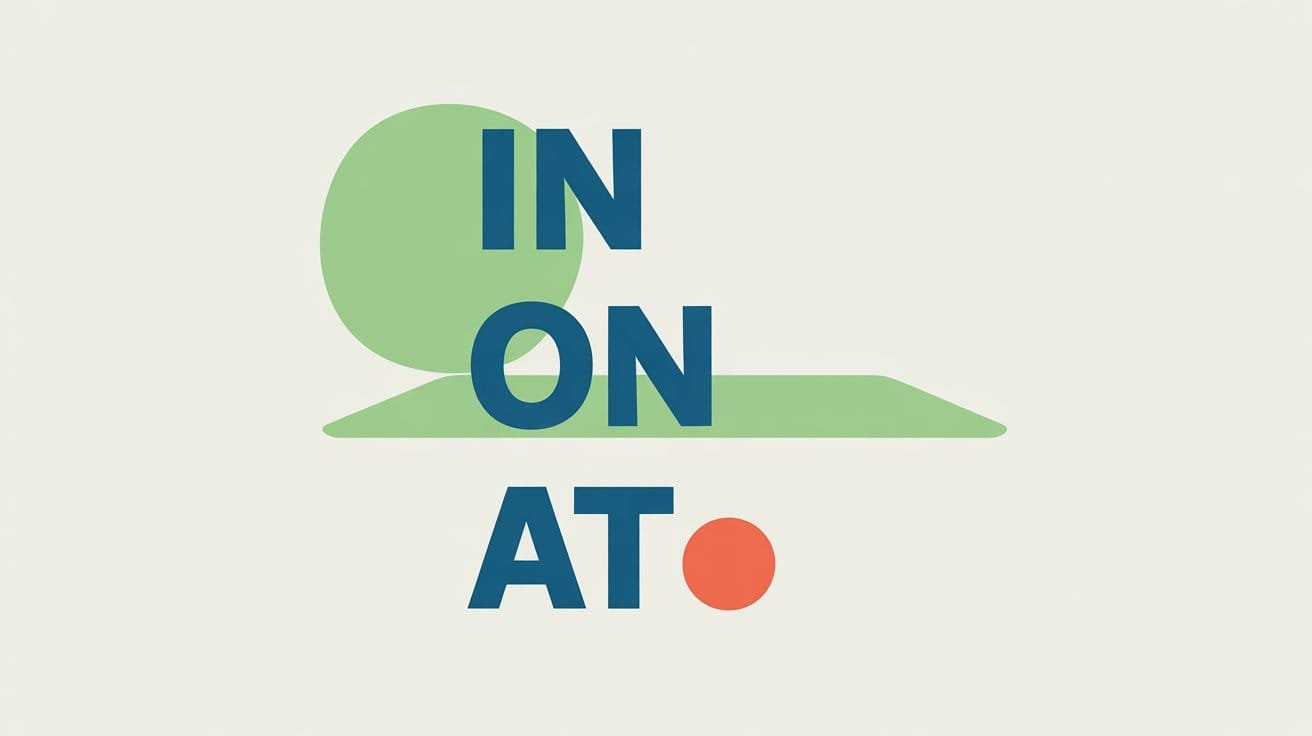
A simple way to think about place:
- In points to space
- On points to surface
- At points to location
Using In, On, and At for Time
When in, on, and at are used for time, the difference depends on how specific the time reference is. The more precise the time, the more likely you are to use at. Broader time periods usually take in.
Using In for Time
Use in with longer periods of time or when the exact moment is not important.
Examples:
- She plans to relocate in July.
- The project began in 2022.
- He usually feels most productive in the morning.
Here, the time is viewed as a general period rather than a specific point.
Using On for Time
Use on with days and dates.
Examples:
- The workshop is scheduled on Friday.
- She submitted the report on March 12.
- They met on a cold winter evening.
In these cases, the time is more specific than a general period but not an exact moment.
Using At for Time
Use at with exact times or precise moments.
Examples:
- The meeting starts at 10 a.m.
- He called her at midnight.
- The store opens at dawn.
Here, the focus is on a clearly defined point in time.
A quick way to remember time usage:
- In for general periods
- On for days and dates
- At for exact times
Common Mistakes with In, On, and At
Even when the basic rules are clear, in, on, and at are still easy to mix up. These mistakes usually happen when the context is not fully considered.
Treating All Places the Same
A common mistake is using one preposition for every type of location.
Examples:
- She is waiting in the bus stop.
- She is waiting at the bus stop.
A bus stop is treated as a point, not an enclosed space. That is why at is the natural choice here.
Mixing Time and Place Rules
Learners often apply time rules to place, or place rules to time.
Examples:
- The meeting is in Friday.
- The meeting is on Friday.
Days and dates take on, not in.
Using At When More Detail Is Needed
Sometimes at is used even when the sentence focuses on the inside of a place.
Examples:
- She works at the office all day but stays in the office late at night.
Use at when the location is a point of activity. Use in when the inside space matters.
Overthinking Simple Situations
Learners sometimes hesitate because more than one option feels possible. In many real situations, English allows flexibility depending on what you want to emphasize. Focus on meaning first. The correct preposition usually becomes clear once the context is clear.
In vs On vs At: Quick Comparison Table
| Preposition | Used For | Think of It As | Example |
|---|---|---|---|
| In | Enclosed spaces, large areas, longer time periods | Inside a space or period | She works in a quiet office. |
| On | Surfaces, days, dates | On a surface or calendar day | The keys are on the table. |
| At | Specific points, exact times, locations as points | A precise point | The meeting starts at 9 a.m. |
When you are unsure, ask yourself:
- Am I talking about inside a space or a long period? → In
- Am I talking about a surface or a day/date? → On
- Am I pointing to a specific place or exact time? → At
This mental check solves most in–on–at confusion quickly.
Frequently Asked Questions About In, On, and At
Can in, on, and at all be correct in the same situation?
Yes, sometimes all three can work, depending on what you want to emphasize. For example, you might say someone is in a building, on a street, or at an address. The place is related, but the focus changes. English allows flexibility when the meaning is clear.
Why do we say at home but in the house?
At home refers to the idea of being present at your place of living. It treats home as a point of activity or state. In the house focuses on being inside the physical building. The difference is about meaning, not formality.
Is it wrong to use at for places like schools or offices?
No, it is not wrong. At is used when the place is treated as a location or activity point. Saying someone works at an office focuses on their job location, while in the office focuses on being inside the building.
How do I choose between in, on, and at when I am unsure?
Ask yourself what you want to highlight. If you are thinking about an enclosed space or a general time period, use in. If you are referring to a surface or a specific day, use on. If you are pointing to an exact time or a precise location, use at. Meaning usually makes the correct choice clear.

The First English Grade Editorial Team creates simple English grammar, vocabulary, and language guides for students, beginners, and everyday learners.