
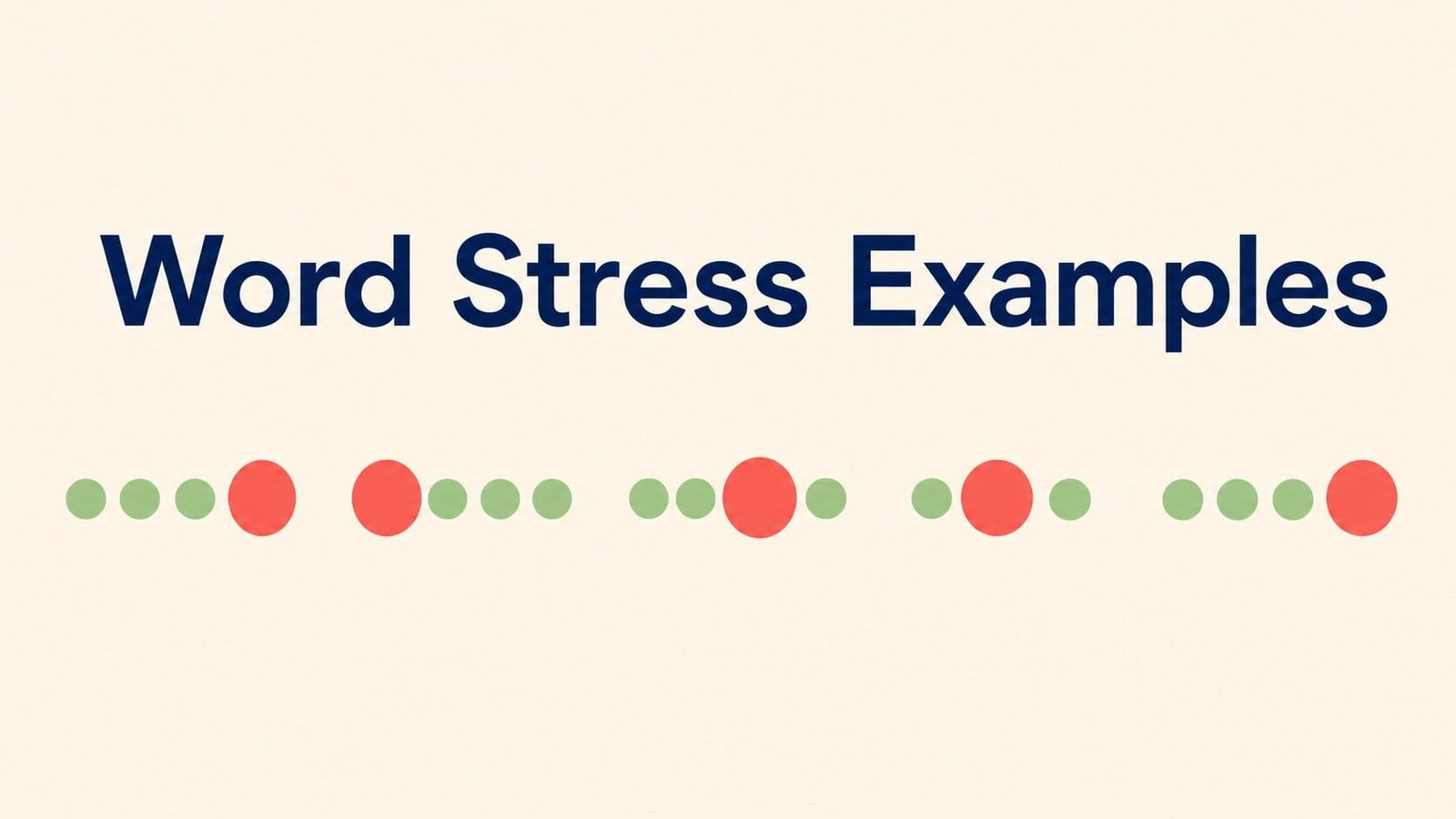
Word stress can change how clear and natural your English sounds. A word may have two, three, or more syllables, but one part is usually spoken more strongly than the others.
For example, TA-ble is stressed on the first syllable, while be-LIEVE is stressed on the second syllable. When the stress moves to the wrong part, the word may still be understood, but it can sound unusual or difficult to catch.
This list gives 250 word stress examples in English with syllable marking. The stressed syllable is written in capital letters, so you can see and practice the stronger part of each word.
How to Read the Syllable Marking
A word is divided into syllables with hyphens. The stressed syllable is shown in capital letters.
Example:
TA-ble = the first syllable is stressed
be-LIEVE = the second syllable is stressed
ed-u-CA-tion = the third syllable is stressed
Word stress may vary slightly by accent, but the patterns below show common English pronunciation.
250 Word Stress Examples List in English
| No. | Word | Syllable Marking | Example Sentence |
|---|---|---|---|
| 1 | Table | TA-ble | The glass table is near the window. |
| 2 | Mother | MOTH-er | Her mother called after lunch. |
| 3 | Teacher | TEACH-er | The teacher explained the rule clearly. |
| 4 | Picture | PIC-ture | This picture shows a small garden. |
| 5 | Window | WIN-dow | Please open the window a little. |
| 6 | Garden | GAR-den | They planted roses in the garden. |
| 7 | Market | MAR-ket | The market closes at seven. |
| 8 | Doctor | DOC-tor | The doctor spoke in a calm voice. |
| 9 | Summer | SUM-mer | We visited the lake in summer. |
| 10 | Winter | WIN-ter | Winter mornings can be quiet. |
| 11 | Music | MU-sic | Soft music played in the room. |
| 12 | Pencil | PEN-cil | She sharpened her pencil. |
| 13 | Paper | PA-per | Write your name on the paper. |
| 14 | Coffee | COF-fee | I ordered black coffee. |
| 15 | Water | WA-ter | Drink enough water today. |
| 16 | Flower | FLOW-er | A yellow flower grew beside the path. |
| 17 | Brother | BROTH-er | My brother arrived early. |
| 18 | Sister | SIS-ter | Her sister studies biology. |
| 19 | Office | OF-fice | The office opens at nine. |
| 20 | Village | VIL-lage | The village has one school. |
| 21 | POCK-et | He put the key in his pocket. | |
| 22 | Ticket | TICK-et | Keep your ticket with you. |
| 23 | Moment | MO-ment | Wait for one moment. |
| 24 | Problem | PROB-lem | This problem has a simple answer. |
| 25 | Answer | AN-swer | Give a clear answer. |
| 26 | Minute | MIN-ute | The meeting starts in one minute. |
| 27 | Planet | PLAN-et | Earth is a planet. |
| 28 | Forest | FOR-est | The forest looked peaceful. |
| 29 | River | RIV-er | A wide river runs through the town. |
| 30 | Corner | COR-ner | Stand near the corner. |
| 31 | Animal | AN-i-mal | The animal moved slowly. |
| 32 | Family | FAM-i-ly | Her family lives nearby. |
| 33 | History | HIS-to-ry | History helps us understand change. |
| 34 | Energy | EN-er-gy | The child has a lot of energy. |
| 35 | Memory | MEM-o-ry | That song brought back a memory. |
| 36 | Company | COM-pa-ny | The company hired new staff. |
| 37 | Library | LI-bra-ry | The library is closed today. |
| 38 | Holiday | HOL-i-day | We planned a short holiday. |
| 39 | Camera | CAM-er-a | The camera battery is low. |
| 40 | Cinema | CIN-e-ma | They went to the cinema. |
| 41 | Calendar | CAL-en-dar | Mark the date on the calendar. |
| 42 | Elephant | EL-e-phant | The elephant walked slowly. |
| 43 | Vegetable | VEG-e-ta-ble | Carrot is a common vegetable. |
| 44 | Hospital | HOS-pi-tal | The hospital is across the road. |
| 45 | Chocolate | CHOC-o-late | She bought a small chocolate bar. |
| 46 | Exercise | EX-er-cise | Daily exercise supports health. |
| 47 | Important | im-POR-tant | This is an important message. |
| 48 | Expensive | ex-PEN-sive | That jacket is too expensive. |
| 49 | Delicious | de-LI-cious | The soup was delicious. |
| 50 | Amazing | a-MAZ-ing | It was an amazing performance. |
| 51 | Correct | cor-RECT | Choose the correct answer. |
| 52 | Polite | po-LITE | A polite reply is always helpful. |
| 53 | Secure | se-CURE | Keep your password secure. |
| 54 | Complete | com-PLETE | Please send the complete form. |
| 55 | Remote | re-MOTE | The remote village had no bus service. |
| 56 | Extreme | ex-TREME | The team worked in extreme heat. |
| 57 | Alone | a-LONE | He waited alone outside. |
| 58 | Around | a-ROUND | We walked around the park. |
| 59 | Between | be-TWEEN | The shop is between two banks. |
| 60 | Before | be-FORE | Wash your hands before dinner. |
| 61 | Behind | be-HIND | The bag is behind the chair. |
| 62 | Across | a-CROSS | They walked across the bridge. |
| 63 | Against | a-GAINST | Do not lean against the wet wall. |
| 64 | Today | to-DAY | Today is a good day to start. |
| 65 | Tonight | to-NIGHT | We may leave tonight. |
| 66 | Become | be-COME | Small actions become habits. |
| 67 | Believe | be-LIEVE | I believe your story. |
| 68 | Decide | de-CIDE | You need to decide soon. |
| 69 | Explain | ex-PLAIN | Can you explain the answer? |
| 70 | Forget | for-GET | Do not forget your notebook. |
| 71 | Invite | in-VITE | They will invite everyone. |
| 72 | Improve | im-PROVE | Practice will improve your speaking. |
| 73 | Protect | pro-TECT | This cover will protect the phone. |
| 74 | Repair | re-PAIR | They will repair the road. |
| 75 | Return | re-TURN | Please return the book tomorrow. |
| 76 | Suggest | sug-GEST | I suggest a shorter title. |
| 77 | Support | sup-PORT | Friends support each other. |
| 78 | Survive | sur-VIVE | Some plants survive in dry soil. |
| 79 | Arrange | ar-RANGE | Arrange the books neatly. |
| 80 | Prepare | pre-PARE | Prepare your notes before class. |
| 81 | Allow | al-LOW | The rules allow extra time. |
| 82 | Appear | ap-PEAR | Stars appear after sunset. |
| 83 | Collect | col-LECT | We collect old stamps. |
| 84 | Control | con-TROL | Try to control the speed. |
| 85 | Create | cre-ATE | They create useful lessons. |
| 86 | Describe | de-SCRIBE | Describe the picture in English. |
| 87 | Develop | de-VEL-op | Children develop at different speeds. |
| 88 | Continue | con-TIN-ue | Continue reading the paragraph. |
| 89 | Remember | re-MEM-ber | Remember to lock the door. |
| 90 | Discover | dis-COV-er | Scientists discover new facts. |
| 91 | Consider | con-SID-er | Consider both options. |
| 92 | Deliver | de-LIV-er | They deliver food at night. |
| 93 | Imagine | i-MAG-ine | Imagine a quiet beach. |
| 94 | Discuss | dis-CUSS | We will discuss the plan. |
| 95 | Provide | pro-VIDE | The school will provide books. |
| 96 | Require | re-QUIRE | Some jobs require training. |
| 97 | Reduce | re-DUCE | Reduce the volume, please. |
| 98 | Review | re-VIEW | Review your notes before the test. |
| 99 | Achieve | a-CHIEVE | You can achieve steady progress. |
| 100 | Admire | ad-MIRE | I admire her patience. |
| 101 | Advance | ad-VANCE | Technology continues to advance. |
| 102 | Agree | a-GREE | I agree with your idea. |
| 103 | Avoid | a-VOID | Avoid noisy places while studying. |
| 104 | Career | ca-REER | Her career began in teaching. |
| 105 | Machine | ma-CHINE | The machine stopped suddenly. |
| 106 | Police | po-LICE | The police arrived quickly. |
| 107 | Hotel | ho-TEL | The hotel faces the sea. |
| 108 | Advice | ad-VICE | His advice helped me. |
| 109 | Concern | con-CERN | This issue is a real concern. |
| 110 | Desire | de-SIRE | She had a strong desire to learn. |
| 111 | Event | e-VENT | The event starts at noon. |
| 112 | Mistake | mis-TAKE | Everyone can make a mistake. |
| 113 | Surprise | sur-PRISE | The party was a surprise. |
| 114 | Delay | de-LAY | The delay lasted one hour. |
| 115 | Success | suc-CESS | Success takes time and effort. |
| 116 | Amount | a-MOUNT | Write the total amount here. |
| 117 | Design | de-SIGN | The design is clean and simple. |
| 118 | Effect | ef-FECT | The effect was easy to notice. |
| 119 | Exchange | ex-CHANGE | The exchange took only a minute. |
| 120 | Respect | re-SPECT | Respect makes conversation easier. |
| 121 | Request | re-QUEST | Please send your request by email. |
| 122 | Account | ac-COUNT | Open a new account online. |
| 123 | Attention | at-TEN-tion | Pay attention to the speaker. |
| 124 | Decision | de-CI-sion | The decision was not easy. |
| 125 | Expression | ex-PRES-sion | Her expression changed quickly. |
| 126 | Condition | con-DI-tion | The car is in good condition. |
| 127 | Position | po-SI-tion | Change your sitting position. |
| 128 | Solution | so-LU-tion | This solution saves time. |
| 129 | Tradition | tra-DI-tion | The tradition continues every year. |
| 130 | Direction | di-REC-tion | Follow the direction on the sign. |
| 131 | Relation | re-LA-tion | There is a clear relation between them. |
| 132 | Collection | col-LEC-tion | The museum has a large collection. |
| 133 | Connection | con-NEC-tion | The internet connection is weak. |
| 134 | Protection | pro-TEC-tion | Wear a helmet for protection. |
| 135 | Suggestion | sug-GES-tion | Her suggestion was practical. |
| 136 | Description | de-SCRIP-tion | The description matched the photo. |
| 137 | Discussion | dis-CUS-sion | The discussion lasted an hour. |
| 138 | Permission | per-MIS-sion | Ask for permission first. |
| 139 | Reflection | re-FLEC-tion | The lake showed a clear reflection. |
| 140 | Selection | se-LEC-tion | The store has a wide selection. |
| 141 | Celebration | cel-e-BRA-tion | The celebration continued all evening. |
| 142 | Education | ed-u-CA-tion | Education changes opportunities. |
| 143 | Information | in-for-MA-tion | The website gives useful information. |
| 144 | Conversation | con-ver-SA-tion | Their conversation was friendly. |
| 145 | Application | ap-pli-CA-tion | Submit the application today. |
| 146 | Communication | com-mu-ni-CA-tion | Clear communication prevents confusion. |
| 147 | Organization | or-gan-i-ZA-tion | The organization helps local families. |
| 148 | Imagination | i-mag-i-NA-tion | Stories build imagination. |
| 149 | Investigation | in-ves-ti-GA-tion | The investigation took several weeks. |
| 150 | Introduction | in-tro-DUC-tion | The introduction was short and clear. |
| 151 | Combination | com-bi-NA-tion | This combination works well. |
| 152 | Observation | ob-ser-VA-tion | Careful observation improves learning. |
| 153 | Population | pop-u-LA-tion | The population grew quickly. |
| 154 | Explanation | ex-pla-NA-tion | The explanation was easy to follow. |
| 155 | Preparation | prep-a-RA-tion | Good preparation reduces stress. |
| 156 | Recommendation | rec-om-men-DA-tion | Her recommendation was useful. |
| 157 | Responsibility | re-spon-si-BIL-i-ty | Responsibility grows with practice. |
| 158 | Opportunity | op-por-TU-ni-ty | This opportunity may not return. |
| 159 | University | u-ni-VER-si-ty | She studies at a university. |
| 160 | Community | com-MU-ni-ty | The community planted trees. |
| 161 | Ability | a-BIL-i-ty | Reading builds language ability. |
| 162 | Activity | ac-TIV-i-ty | Choose one activity for Friday. |
| 163 | Creativity | cre-a-TIV-i-ty | Creativity helps in writing. |
| 164 | Security | se-CUR-i-ty | Security checked every bag. |
| 165 | Majority | ma-JOR-i-ty | The majority agreed with the plan. |
| 166 | Minority | mi-NOR-i-ty | A minority preferred another date. |
| 167 | Variety | va-RI-e-ty | The menu has a variety of dishes. |
| 168 | Anxiety | anx-I-e-ty | Deep breathing may ease anxiety. |
| 169 | Society | so-CI-e-ty | Rules shape society. |
| 170 | Economy | e-CON-o-my | The economy changed after the crisis. |
| 171 | Democracy | de-MOC-ra-cy | Democracy depends on public voice. |
| 172 | Technology | tech-NOL-o-gy | Technology changes how we work. |
| 173 | Biology | bi-OL-o-gy | Biology explains living things. |
| 174 | Geography | ge-OG-ra-phy | Geography teaches us about places. |
| 175 | Photography | pho-TOG-ra-phy | Photography captures small details. |
| 176 | Psychology | psy-CHOL-o-gy | Psychology studies the mind. |
| 177 | Apology | a-POL-o-gy | His apology sounded sincere. |
| 178 | Equality | e-QUAL-i-ty | Equality matters in every classroom. |
| 179 | Reality | re-AL-i-ty | Reality was different from the plan. |
| 180 | Electricity | e-lec-TRIC-i-ty | The storm cut the electricity. |
| 181 | Curiosity | cu-ri-OS-i-ty | Curiosity makes learning easier. |
| 182 | Possibility | pos-si-BIL-i-ty | There is a possibility of rain. |
| 183 | Flexibility | flex-i-BIL-i-ty | Flexibility helps busy families. |
| 184 | Availability | a-vail-a-BIL-i-ty | Check the availability before booking. |
| 185 | Reliability | re-li-a-BIL-i-ty | Reliability is important in this job. |
| 186 | Accessibility | ac-ces-si-BIL-i-ty | Accessibility improves public services. |
| 187 | Facility | fa-CIL-i-ty | The facility has a training room. |
| 188 | Identity | i-DEN-ti-ty | Keep your identity private online. |
| 189 | Priority | pri-OR-i-ty | Health should be a priority. |
| 190 | Authority | au-THOR-i-ty | The authority approved the request. |
| 191 | Capacity | ca-PAC-i-ty | The hall reached full capacity. |
| 192 | Beauty | BEAU-ty | Beauty appears in simple things. |
| 193 | Busy | BUS-y | The street is busy today. |
| 194 | Lucky | LUCK-y | He felt lucky after the match. |
| 195 | Empty | EMP-ty | The room was empty. |
| 196 | Heavy | HEAV-y | This bag is heavy. |
| 197 | Simple | SIM-ple | Use a simple sentence. |
| 198 | Honest | HON-est | An honest answer builds trust. |
| 199 | Modern | MOD-ern | The house has a modern design. |
| 200 | Silent | SI-lent | The class became silent. |
| 201 | Golden | GOLD-en | The field looked golden at sunset. |
| 202 | Careful | CARE-ful | Be careful with the glass. |
| 203 | Useful | USE-ful | This chart is useful. |
| 204 | Helpful | HELP-ful | Your notes were helpful. |
| 205 | Peaceful | PEACE-ful | The village was peaceful. |
| 206 | Friendly | FRIEND-ly | The staff were friendly. |
| 207 | Clearly | CLEAR-ly | Speak clearly in the interview. |
| 208 | Early | EAR-ly | They arrived early. |
| 209 | Slowly | SLOW-ly | Walk slowly on the wet floor. |
| 210 | Quickly | QUICK-ly | She quickly finished the task. |
| 211 | Daily | DAI-ly | Daily practice improves fluency. |
| 212 | Natural | NAT-u-ral | Use a natural tone. |
| 213 | Personal | PER-son-al | Keep personal details safe. |
| 214 | Physical | PHYS-i-cal | Physical activity supports fitness. |
| 215 | Medical | MED-i-cal | She needs medical advice. |
| 216 | Musical | MU-si-cal | The play has a musical ending. |
| 217 | Central | CEN-tral | The central station is crowded. |
| 218 | General | GEN-er-al | Give a general answer first. |
| 219 | Several | SEV-er-al | Several students raised their hands. |
| 220 | Federal | FED-er-al | A federal office handles the request. |
| 221 | Digital | DIG-i-tal | Digital tools save time. |
| 222 | Regional | RE-gion-al | The regional team won the game. |
| 223 | National | NA-tion-al | The national park is beautiful. |
| 224 | Cultural | CUL-tur-al | Cultural events bring people together. |
| 225 | Possible | POS-si-ble | Choose the possible answer. |
| 226 | Comfortable | COM-fort-a-ble | The chair is comfortable. |
| 227 | Reasonable | REA-son-a-ble | That price seems reasonable. |
| 228 | Available | a-VAIL-a-ble | The room is available tomorrow. |
| 229 | Reliable | re-LI-a-ble | This source is reliable. |
| 230 | Creative | cre-A-tive | A creative idea can solve the problem. |
| 231 | Effective | ef-FEC-tive | The method was effective. |
| 232 | Productive | pro-DUC-tive | We had a productive meeting. |
| 233 | Attractive | at-TRAC-tive | The cover looks attractive. |
| 234 | Positive | POS-i-tive | Keep a positive attitude. |
| 235 | Negative | NEG-a-tive | The result was negative. |
| 236 | Sensitive | SEN-si-tive | This is a sensitive topic. |
| 237 | Active | AC-tive | Stay active during the day. |
| 238 | Passive | PAS-sive | The sentence uses passive voice. |
| 239 | Massive | MAS-sive | A massive tree fell in the storm. |
| 240 | Public | PUB-lic | The park is open to the public. |
| 241 | Private | PRI-vate | Keep the message private. |
| 242 | Basic | BA-sic | Start with the basic rule. |
| 243 | Classic | CLAS-sic | This is a classic story. |
| 244 | Elastic | e-LAS-tic | The elastic band broke. |
| 245 | Fantastic | fan-TAS-tic | The view was fantastic. |
| 246 | Domestic | do-MES-tic | Domestic flights leave from this terminal. |
| 247 | Specific | spe-CIF-ic | Give a specific example. |
| 248 | Scientific | sci-en-TIF-ic | Scientific research takes time. |
| 249 | Automatic | au-to-MAT-ic | The door has an automatic lock. |
| 250 | Democratic | dem-o-CRAT-ic | They followed a democratic process. |
Common Word Stress Patterns in English
English word stress is not always easy to guess, but some patterns can help.
1. Many two-syllable nouns and adjectives stress the first syllable
Examples include TA-ble, MOTH-er, PIC-ture, SIL-ent, and MOD-ern.
This pattern is common, but it is not a rule for every word. Words such as ad-VICE, ca-REER, and ho-TEL have stress on the second syllable.
2. Many two-syllable verbs stress the second syllable
Examples include be-LIEVE, de-CIDE, ex-PLAIN, re-TURN, and pro-TECT.
This is why many action words sound stronger near the end.
3. Words ending in -tion often stress the syllable before -tion
Examples include ed-u-CA-tion, con-ver-SA-tion, in-for-MA-tion, and ap-pli-CA-tion.
The ending -tion itself is usually not stressed. The stress normally falls just before it.
4. Words ending in -ity often stress the syllable before -ity
Examples include a-BIL-i-ty, cre-a-TIV-i-ty, se-CUR-i-ty, and pos-si-BIL-i-ty.
This pattern is helpful because many longer English words use this ending.
5. Words ending in -logy often stress the syllable before -logy
Examples include bi-OL-o-gy, psy-CHOL-o-gy, and tech-NOL-o-gy.
This is a useful pattern for academic and subject-related words.
Why Word Stress Matters
Word stress helps listeners recognize words more easily. Even when the individual sounds are correct, misplaced stress can make a word harder to understand.
For example, TA-ble sounds natural because the first syllable is stronger. If the second syllable is made stronger, the word may sound unusual. The same happens with words such as be-LIEVE, im-POR-tant, and ed-u-CA-tion. The stressed part guides the rhythm of the word.
A good way to practice is to say each word slowly, clap once for each syllable, and make the stressed syllable stronger. Then say the full sentence naturally.
Simple Practice Method
Choose five words from the list each day. Say the syllables first, then say the whole word, then use it in the sentence.
Example practice:
in-for-MA-tion
information
The website gives useful information.
Repeat this with different words until the stress begins to sound natural.

The First English Grade Editorial creates simple English grammar, vocabulary, and language guides for students, beginners, and everyday learners.